Quality Management in 2026: Considerations to Successfully Adapt to a Transforming Environment

Introduction

The accounting firm industry experienced a ground-breaking transaction in August of 2021 when TowerBrook acquired EisnerAmper, which marked the first private equity (“PE”) transaction of a large-scale accounting firm. This transaction was structured using an alternative practice structure (“APS”).


Historically, licensing and independence rules have barred non-CPAs from owning accounting firms. Through an APS, a PE firm may invest in the non-attest entity with service lines such as tax advisory and consulting. The CPA partners retain control over the attest functions, which preserves regulatory compliance. While the APS model has been in existence since the 1990s, this August 2021 transaction brought new attention to this structure. What has followed is an extraordinary volume of deal activity.


Per the CPA Trendlines (“CPAT”) Cornerstone report posted on November 18, 2025, CPAT has tracked over 115 PE-related transactions from 2020 to 2025, with over 80 transactions in 2025. While PE in the accounting firm space is no longer news, the pace and volume of transactions is certainly news-worthy.


Impact of PE Investment

The impact of PE investment on the accounting firm space is unprecedented. The APS has enabled PE to fuel billions of capital investment. PE-backed firms provide immediate payouts to partners at appealing valuations while providing access to capital to these firms for merger and acquisition growth, technology investments, and other priorities. Well-capitalized firms now have an improved ability to invest in technological capabilities, attract experienced talent to be more competitive for college graduates, and improve their market position.


With new technologies, routine tasks are being automated such as data entry, tie-outs and controls testing, resulting in less time needed to perform certain audit procedures.


What the regulators are saying

At the AICPA December 2025 conference on Current SEC and PCAOB Developments, common topics were the presence of private equity in the accounting firm space and the opportunities and challenges that come with this investment.


PCAOB

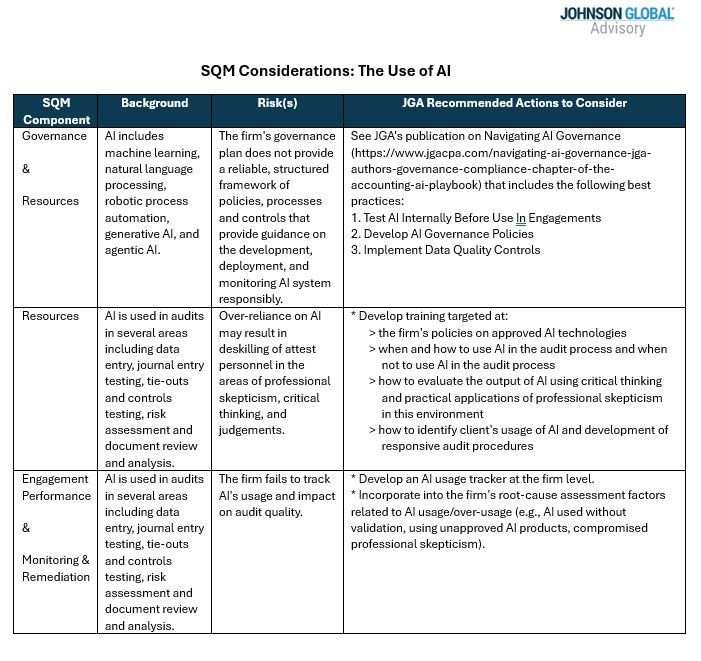
Acting PCAOB Chair George Botic described that both transformative technologies (e.g., artificial intelligence or “AI”) and the continuing expansion of private equity investments in accounting firms are two developments that bring opportunities and challenges. Mr. Botic noted that while AI has enhanced risk assessment, reduced manual processes and made it possible to efficiently analyze entire populations of data (which can reduce the risk of missing irregularities or unusual patterns), that overreliance on AI may ultimately threaten auditors’ exercise of professional skepticism and judgment.  As it relates to private equity, Mr. Botic noted that while these investments have the potential to enhance audit quality by increasing firm capacity and modernizing audit tools with advanced technologies, the presence of private equity presents a risk that firms shift incentives to prioritize profitability over audit quality. Mr. Botic stated, “Both AI and private equity investments in accounting firms carry the potential to truly reshape the profession. Yet these opportunities come with clear challenges to ensure that overreliance on AI and the pressures of private equity do not jeopardize audit quality.”


SEC

SEC Chair Atkins discussed in his remarks that he would like the PCAOB to modify its inspections process to place more reliance on the system of quality management and that inspection of certain engagements would inform the PCAOB if the firm’s system of quality management is effective. He also expressed a view that accountability for audit quality should move upward to firm leadership.
 

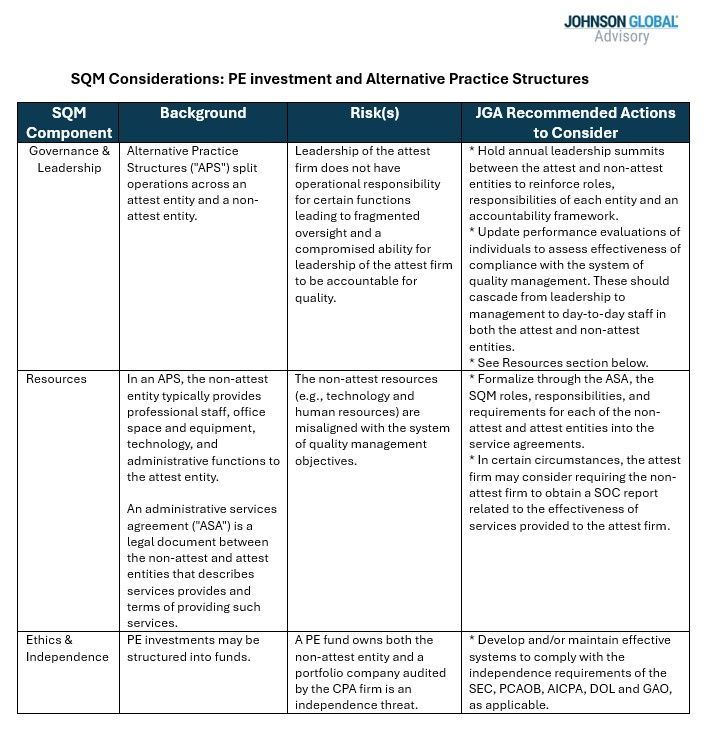
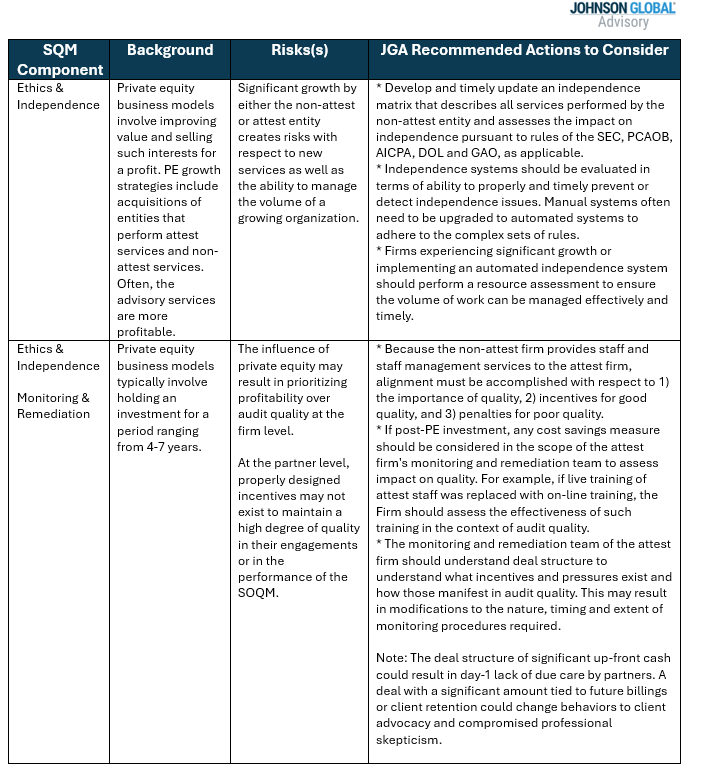
How is a firm’s system of quality management (“SQM”) impacted?

Today’s transforming environment has far-reaching impacts on a firm’s SQM. This publication will focus on risk assessment, governance and leadership, ethics and independence, resources, engagement performance, and monitoring and remediation. 


Conclusion

The APS comes with structural complexity that challenges the design and operation of effective systems of quality management. Key risks include independence impairments, fragmented governance, and inconsistent risk monitoring. When an APS is coupled with PE investment, use of transformative technologies, profit prioritization and pressure may be added to the mix of risks at play.


The regulators have weighed in on the importance of these topics. We advise firms to carefully assess these issues to ensure they implement robust governance frameworks, establish clear accountability, and enhance monitoring protocols to mitigate these risks.


Ready to get started or need help refining your approach? Contact your JGA audit quality expert today to schedule a consultation and ensure implementation is tailored to your firm’s needs. 


By Jackson Johnson January 20, 2026
JGA is pleased to announce that Joe Lynch , JGA Shareholder, will be a featured guest on the upcoming AICPA & CIMA A&A Focus live webcast on February 4, 2026. Joe has been invited to join the program to provide insights on changes to engagement quality review requirements. This appearance offers a valuable opportunity for viewers to gain practical, real-time guidance on effective EQR practices—an increasingly critical component of audit quality and compliance under the evolving professional standards landscape. Click here for m ore information about the program and registration details. At Johnson Global Advisory, we support firms in selecting, implementing, and optimizing these tools to meet their unique needs. For more insights, visit our blog or contact us to learn how we can help your firm AmplifyQuality®. For more information, please contact your JGA audit quality expert .
By Jackson Johnson December 30, 2025
As we wrap up an incredible year, we’re showcasing the insights that sparked the most conversations and drove the most impact. Here are the Top 10 Actionable Insights from 2025: Use of Other Auditors: Managing Risk and the New PCAOB Standard ISQM 1, SQMS 1: Influencing the Firm on the Benefits Beyond Compliance (Part II) Case Study – Example Successor Auditor Considerations QC 1000 Implementation: Key Themes and Guidance from the PCAOB Workshop Clearing the Roadblocks: Auditing Estimates with Confidence in Small Firms Enhancing Auditor Independence: Key Themes from PCAOB Recent Spotlight The Never-Ending Story: How to Remediate Recurring EQR Findings – Part Deux Cryptic Audits of Crypto Assets: Auditing Digital Assets Innovative Solutions for QC 1000, SQMS 1, & ISQM 1: Quality Management tools in the Marketplace Enhancing Audit Evidence: PCAOB Expectations and What We Are Seeing in Practice
By Stephanie Mickens November 24, 2025
As companies increasingly rely on cloud platforms, external data providers, and integrated third-party systems, the boundary between “internal” and “external” information has blurred. Audit evidence today may originate outside the company, but often arrives through the company, transformed, mapped, merged, or embedded within systems before it reaches the auditor. In response to this evolving landscape, the PCAOB amended AS 1105, Audit Evidence, effective for audits of fiscal years beginning on or after December 15, 2025. Central to these amendments is AS 1105.10A, which introduces a principle-based, risk-scalable framework for evaluating the reliability of electronic information provided by the company. At JGA, we view this development as a natural response to the data ecosystems shaping today’s financial reporting. We also see it rapidly becoming a recurring area of focus by global audit regulators, particularly when the information supports significant risks, revenue, fraud procedures, or management estimates. This article summarizes key themes from the PCAOB’s Board Policy Statement on Evaluating External Electronic Information (issued September 2025) paired with practical observations from JGA’s inspection support and methodology enhancement work with firms across the profession. Why External Electronic Information is a Growing Focus Area Across industries, external platforms now drive core financial and operational processes: payment processors, logistics platforms, third-party fulfillment solutions, subscription systems, industry data services, and more. Although such information originates from outside the company, it is often: Received, stored, or routed through company systems Transformed within spreadsheets or EUCs Merged with internally generated data Exported in formats that allow modification Provided to auditors without a traceable chain to the original source. Our direct experience working with our clients shows that PCAOB inspection teams consistently emphasize that external does not inherently mean reliable. The auditor must understand how the information was obtained, how it was handled, and whether there was a reasonable possibility that it could have been modified before reaching the auditor. Understanding AS 1105.10A The Board Policy Statement highlights two foundational expectations: 1. Auditors should understand the source and flow of the information. Inspection teams frequently question whether the engagement team understood: The true originating source of the data How the company received it (e.g., automated feed vs. manual upload) Whether the information is editable or configurable Whether it passed through multiple systems or spreadsheets How it is used in controls, substantive testing, or significant estimates In JGA’s experience, inspection findings often arise from situations where teams relied on a “system-generated” or “externally sourced” report without fully understanding where it came from or whether it could have been changed. 2. Auditors should address the risk of modification. The standard allows for two broad approaches, testing the information itself or relying on controls, depending on the assessed risk. The standard is intentionally flexible, but this flexibility requires well-supported judgments, especially for information affecting significant accounts or fraud risks. The PCAOB also acknowledged scenarios where separate testing may not be required (e.g., direct-to-auditor feeds or read-only API transfers) but emphasized that this exception applies only when the risk of modification is no more than remote. What We Observe in PCAOB Inspections Through JGA’s transformation activities with firms, we continue to see consistent challenges in the following areas: Reliance on information provided by the company without evaluating whether transformed, filtered, or merged with other data sets. Use of external or industry data in analytics without understanding the methods, assumptions, or relevance to the issuer. External information embedded in significant estimates or complex models without evaluating management’s process for compiling that information. System-generated or external journal entry listings used in fraud procedures without establishing completeness and reliability. In each of these situations, inspection teams focus on whether engagement teams understood how the information was obtained, how it was processed, and whether there was a reasonable possibility of modification before it reached the auditor. Emerging PCAOB Expectations Although the standard is principles-based, several expectations are now appearing consistently in inspections: Reliability cannot be presumed, external information must be evaluated just like any other audit evidence. Understanding the company’s process for receiving and handling external information is foundational. Judgments about whether separate testing is required must be risk-responsive and well-supported. Documentation should clearly articulate the source of the information, the company’s process, and the basis for concluding the information was reliable. These expectations are shaping how firms need to think about IPE testing, data flows, and the role of technology within the audit. Areas Where Firms Often Seek Assistance Across our methodology enhancement and inspection support work, firms consistently ask for help in: Identifying when information is “external electronic information provided by the company”. Determining whether reliance on management’s process is appropriate. Navigating situations where data passes through multiple systems or spreadsheets. Evaluating third-party or industry data used in analytics. Assessing effects on significant risks, especially revenue and fraud. Aligning documentation practices with PCAOB expectations. Many firms have strong processes for testing IPE, but other nuances of the standards require an additional layer of consideration that is still evolving in practice. Looking Ahead As companies build increasingly automated and interconnected systems, auditors must deepen their understanding of those environments to obtain sufficient appropriate evidence. Firms that proactively adapt their methodologies and train engagement teams will be better positioned for both compliance and audit quality. At JGA , we help firms interpret emerging regulatory requirements, strengthen methodologies, and enhance the use of technology and data in the audit. Ultimately, ensure compliance and consistency get to our ultimate goal of helping firms grow and scale responsibly. To learn how we can help your firm navigate these expectations and #AmplifyQuality, visit www.johnson-global.com, or contact a member of your JGA client service team.
By Jackson Johnson November 6, 2025
WASHINGTON, D.C. Johnson Global Advisory (JGA) is pleased to announce Boyd O’Rourke as a Managing Director, focused on helping audit firms meet their strategic objectives with audit quality in mind. With 30 years of experience in public accounting, Boyd has deep experience in firm management, strategy, risk management, and quality control. Boyd’s skillset complements JGA’s core services by adding new firm strategy and risk management service offerings. “ I have a passion for building high-functioning groups inside accounting firms,” said Boyd. “With private equity firmly in the accounting firm space, service line growth, acquisitions, and consolidation are happening at record speed. JGA’s goal is to help firms manage this growth while limiting exposure to regulatory and business risks. I am excited to advise firms navigating this most-critical period of their journey. ” Most recently, Boyd held multiple senior roles at CBIZ CPAs (formerly Mayer Hoffman McCann P.C.), including Executive Committee Member, National Practice Leader, Chief Risk and Quality Officer, National Director of Quality Control, Mid-west Regional Attest Practice Leader, and National Training Director. “ By most measures, Johnson Global Advisory is a small consulting firm—but over the past eight years, our impact on individual firms and the global profession as a whole has been vastly disproportionate to our size,” said Jackson Johnson, President and Founding Shareholder, JGA. “That is only possible because every professional that joins the JGA team brings deep senior-level experience, technical expertise, and a genuine ability to connect with our clients around the world. I am especially grateful that Boyd O’Rourke has chosen JGA as the platform to share his leadership and expertise to help firms grow and scale. Having known Boyd for several years, I’ve seen firsthand his commitment and executive approach to solving complex problems affecting public accounting firms. His decision to join us is a testament to the unique opportunities JGA offers—and to our shared mission of making a meaningful difference for our clients and the industry .” Boyd is based in the Kansas City area and received his Bachelor of Business Administration in Accounting from the University of Iowa. To learn more about Boyd and the full JGA team, read here . At Johnson Global Advisory , we support firms in selecting, implementing, and optimizing solutions and tools to meet their unique needs. For more insights, visit our blog or contact us to learn how we can help your firm AmplifyQuality®.
By Geoff Dingle October 28, 2025
In September 2022, we wrote an article discussing the struggle that firms were experiencing at that time in remediating Quality Control (QC) criticisms as it relates to their Engagement Quality Review (EQR) process. This struggle seemingly continues today, as, so far in 2025, the PCAOB has publicly re-released previously issued inspection reports for 32 registered firms, and in 19 of those reports, EQR was a QC criticism that was released to the public as these firms had failed to satisfactorily remediate their EQR QC criticism¹. This means that firms continue to struggle to identify and effectively implement remedial actions to the satisfaction of the PCAOB that demonstrate that they have successfully remediated their non-compliance with AS 1220, Engagement Quality Review . So why are firms still failing to remediate this QC criticism? As we stated previously, having worked with engagement teams and looking at the nuanced and sometimes detailed nature of some of the PCAOB Part I findings, attributing the audit issue to a deficient EQR review can sometimes feel like the regulator is being overly exigent. In fact, in its adopting release to the EQR standard , the Board stated that it “…has been sensitive to commenters' concerns and agrees that the EQR should not become, in effect, a second audit.” This is a difficult concept for EQRs to balance though, as engagement teams often ask us, “As EQR am I required to review every test of design and operating effectiveness for internal controls related to every significant risk? Which substantive workpapers in significant risk audit areas should I review and to what level of detail?” Though not explicitly required in AS 1220, implicitly by the very nature of the EQR attribution, the PCAOB is inherently creating an expectation of a detailed EQR review. After all, AS 1220.09 does require the EQR to “review documentation.” When the PCAOB evaluates a firm’s Rule 4009 remediation response, they pay particular attention to recurring deficiencies. If the same deficiency is long-standing or occurs in subsequent reports, remediation efforts undertaken must be incremental in each remediation submission so as to address the recurring deficiency. Said otherwise, a firm cannot deliver the same training year after year and expect it to drive change; it must change its approach to remediate the recurring deficiencies. We have numerous clients telling us that this is the second or third inspection report that includes an EQR QC criticism. They often ask us, “This time, what can we do that is incremental that we haven’t already done?” Remediation Considerations The new quality control standards (QC 1000, ISQM 1 and SQMS1) require firms to perform root cause analyses for audit deficiencies. In doing so, firms should identify the real root cause behind why EQRs are failing to identify audit deficiencies and then design specific remedial actions to address these root causes. So, remedial action should be in response to the actual root cause of the EQR deficiency – i.e., what is the ultimate root cause of EQR’s not identifying the Part I deficiencies at the time of their review? The following are typical actions that we see firms undertake: a. Training as an Action For many firms, they start out the remedial process by providing training to audit professionals that specifically address the requirements of AS 1220. Some firms attempt this by sourcing online training from the marketplace. If this is the first time your firm has received a Part II EQR criticism, then this action might be effective. However, training designed to remediate quality control deficiencies must be specific to the facts and circumstances of your issue(s). Oftentimes though, when the EQR criticism is long-standing or repetitive, training alone is not sufficient. Key takeaway : Consider developing more robust training that specifically addresses nuances of firm findings and walk through examples of EQR reviews. b. EQR Sign-off Checklist as an Action Another common remedial action is for firms to make enhancements to their methodology, including their EQR sign-off checklist . Most firms subscribe to audit software programs already which have a basic EQR checklist that calls out the requirements under AS 1220. Modification to the EQR checklist and/or creation of addendums that specifically focus on the issues or concerns can be a meaningful improvement and can add rigor to the review process. Key takeaway : Firms should determine whether they need to modify their EQR sign-off checklist and/or create addendums to include specific bullets and questions addressing firm audit deficiencies, specifically calling it out to the EQR’s attention. c. EQR mentoring/coaching program as an Action Many firms have already implemented the previous two actions, and they may continue to see deficiencies in the QC criticism. The PCAOB is expecting firms to do more to ensure quality audits. As we have worked with firms on remediation, we recommend firms consider an EQR mentoring/coaching program . When designed and implemented properly – and timely – we believe this action to be important to a successful remediation of QC deficiencies around the EQR function. Key takeaway : Consider designing and implementing an EQR coaching or mentoring program, paying close attention to key elements important for effective remediation criteria. Other Considerations Given that global audit regulators have raised the bar in expectations on recurring findings – specifically on the EQR process – we cannot stress enough the importance of beginning the remediation process early . Engage the PCAOB in a dialogue immediately once your 12-month remediation period begins, to discuss the planned remedial actions and get feedback on the sufficiency of those actions. Pay particular attention to understanding what is considered timely implementation. Do not underestimate the amount of time it will take to fully implement remedial actions. Key takeaway : Engage the PCAOB early in the remediation process to seek feedback on the sufficiency of the remedial actions (perhaps even before the final report has been issued). EQR as last line of defense Another important point is that EQRs are essentially the last line of defense with regard to audit quality. Said differently, audit quality starts with the audit engagement team and the firm’s entire QC system (training, methodology, tools, etc.) that enables and supports audit engagement teams to perform quality audits. Firms must also consider the remedial actions that also address the PCAOB’s Part I audit deficiency(ies). The EQR QC criticism, while linked to its own standard, is really just the review of the audit work performed under all the other audit standards (e.g., AS 2501, AS 1301, etc.). It is a collective effort, and the EQR as well as the entire engagement team should be considered when remediating all QC criticisms identified in firm inspection reports. It may feel like a never-ending story and perhaps regulators are being overly rigorous, but the reality is this issue is not going away, so firms need to consider what incremental actions they can take to truly ensure EQRs perform quality reviews. At Johnson Global Advisory , we support firms in selecting, implementing, and optimizing these tools to meet their unique needs. For more insights, visit our blog or contact us to learn how we can help your firm AmplifyQuality®. ¹ Part I of a PCAOB inspection report contains audit deficiencies; this part is made public when the report is initially published. Part II contains the firm’s QC criticism(s); and this part is not initially released to the public. The firm has one year from the date the report is published to remediate the QC criticism(s). If the remediation is satisfactory to the Board, then Part II is kept private. However, if the firm fails to satisfactorily remediate the QC criticism, the QC criticism in Part II is then released to the public.
By Jackson Johnson September 30, 2025
With the effective date for SQMS 1 and QC 1000 fast approaching, firms of all sizes—especially small and sole practitioners—must take action to implement a system of quality management (SQM) that meets the new standards. The good news? You don’t have to start from scratch. Despite QC 1000’s implementation date deferral, the AICPA’s date hasn’t changed, and the international standards are already effective. It’s important to maintain momentum on the efforts toward implementation of all applicable standards for your firm. This article outlines 10 practical steps to help firms build their SQM. Each step includes actionable guidance and considerations for firms with limited resources, and ties into JGA’s broader thought leadership on quality management, risk assessment, and system evaluation. The 10 Steps to Build Your SQM Step 1: Establish a Project Team Form a team with the right mix of quality expertise and operational insight. For small firms, this may mean involving a manager who can grow into a leadership role or setting aside dedicated time as a sole practitioner. Recommended actions to consider: Identify internal champions with interest or experience in quality. Schedule recurring project meetings to maintain momentum. Join a peer group for support and shared learning. Step 2: Understanding and Awareness Document your firm’s business strategy, service offerings, and operational conditions. This step helps identify factors that may impact quality—such as remote work, new industries, or staff turnover. Recommended actions to consider: Conduct a strategy review with firm leadership. List recent changes in firm structure or engagement types. Use these insights to inform your risk assessment. Step 3: Assign Responsibilities Define who is accountable for the SQM. The new standards require clear delineation of ultimate and operational responsibility, including oversight of independence and monitoring. Recommended actions to consider: Assign roles based on existing responsibilities. Clarify delegation boundaries for managing partners. Document responsibilities in your quality manual. Step 4: Establish a Risk Assessment Function Design a process to identify and assess quality risks. This includes understanding conditions or events that could impact quality objectives. Recommended actions to consider: Create a risk assessment policy tailored to your firm. Use relatable examples to demystify risk factors. Leverage AICPA practice aids for structure and templates. Step 5: Perform the Initial Risk Assessment Conduct brainstorming sessions by component and document risks using the AICPA Risk Assessment Template. Include both formal and informal responses. Recommended actions to consider: Use the AICPA risk library to identify common risks. Tailor risks to your firm’s size and services. Include existing responses—even if informal—for evaluation. Step 6: Finalize the Gap Analysis Evaluate where your current responses fall short. This may include undocumented policies or areas where responses don’t fully address the risk. Recommended actions to consider: Identify gaps in governance, ethics, and technology. Determine which informal practices need formalization. Prioritize gaps based on risk severity and regulatory impact. Step 7: Implement Responses to Address the Gaps Develop policies and procedures to close gaps. Responses must be documented and operational. Recommended actions to consider: Draft policies that reflect your firm’s values and risks. Link procedures to specific quality objectives. Use existing documentation as a starting point. Step 8: Update Your Monitoring Process Move beyond peer review prep—monitoring should be continuous and system-wide. Recommended actions to consider: Assign monitoring responsibilities across the team. Incorporate testing of responses into internal inspections. Use dashboards or checklists to track progress. Step 9: Formalize Root Cause and Remediation Procedures Investigate deficiencies and document why they occurred. This step is essential for both system and engagement-level reviews. Recommended actions to consider: Conduct interviews to understand root causes. Use findings to improve policies and training. Apply remediation even if your firm only undergoes engagement reviews. Step 10: Initial Test of Design and Implementation Review documentation and walk through processes to ensure your system is operational and testable. Recommended actions to consider: Validate that each component is supported by evidence. Simulate a peer review to test your system. Confirm that objectives, risks, and responses align. Conclusion Implementing a system of quality management is not just a compliance exercise—it’s an opportunity to strengthen your firm’s foundation for audit quality, risk management, and long-term success. Whether you’re a sole practitioner or a small firm with a few partners, these 10 steps offer a scalable roadmap to meet the new standards. Ready to get started or need help refining your approach? Contact your JGA audit expert today to schedule a consultation and ensure your implementation is tailored to your firm’s needs. At Johnson Global Advisory , we support firms in selecting, implementing, and optimizing these tools to meet their unique needs. For more insights, visit our blog or contact us to learn how we can help your firm AmplifyQuality®.
By Jackson Johnson September 30, 2025
Introduction Auditing accounting estimates has long been one of the most judgment-intensive and inspection-prone areas of the audit. For smaller firms, the challenge is even greater due to limited resources and evolving regulatory expectations. At JGA , we’ve worked closely with firms navigating these complexities and have identified three critical areas where auditors can strengthen their approach and reduce risk. What’s Recurring and What’s New: Insights from PCAOB’s Latest Audit Focus The PCAOB’s recent Audit Focus¹ underscores persistent deficiencies in how auditors evaluate accounting estimates. Common issues include failure to identify significant assumptions, reliance on inquiry or simple recalculations, and inadequate testing beyond vouching to internal or external data. These recurring gaps continue to surface in inspections of smaller firms. What’s new is a sharper emphasis on critical accounting estimates—those with high uncertainty and material impact. Auditors are now expected to understand how management analyzes the sensitivity of assumptions to other likely outcomes and to incorporate that understanding into their evaluation of bias and reasonableness. Additionally, the PCAOB highlights good practices such as updating internal guidance, enhancing EQR partner reviews, and aligning audit programs with the standards. Key Takeaways and Our Recommended Action Items 1. Evaluate the Reasonableness of Significant Assumptions What the PCAOB said: The PCAOB continues to observe recurring deficiencies in how auditors evaluate significant assumptions used in accounting estimates. Common issues include failing to identify key assumptions, relying solely on inquiry or recalculations, and not assessing whether assumptions are consistent with external factors like market conditions or industry trends. Auditors are expected to evaluate assumptions both individually and in combination, and to consider management’s intent and ability to carry out specific actions when assumptions are forward-looking². JGA’s reaction: In our article “Like Making Concrete out of Jell-O”², we described the inherent difficulty of auditing estimates that are subjective, uncertain, and often based on future projections. We emphasized that auditors must go beyond surface-level validation and challenge management’s assumptions with rigor. In “An Update for Unprecedented Times”³, we noted that economic volatility has made assumption testing even more complex, requiring auditors to evaluate whether recurring assumptions still hold in today’s environment. JGA’s recommendation: Firms should implement structured assumption testing protocols that go beyond vouching. Use external data sources to validate assumptions and ensure that engagement teams document how each assumption was evaluated. Partner and EQR reviews should include a step to confirm that all significant assumptions were tested for reasonableness and consistency. 2. Develop Independent Expectations and Use Reliable Data What the PCAOB said: AS 2501 outlines three approaches to testing estimates, including developing an independent expectation. The PCAOB stresses that auditors must have a reasonable basis for their own assumptions and methods and must evaluate the relevance and reliability of third-party data. This is especially important when using unobservable inputs or when substituting auditor assumptions for those used by management². JGA’s reaction: We’ve consistently advocated independent modeling as a way to reduce bias and improve audit quality. In our earlier articles, we highlighted how auditors can use historical data, peer comparisons, and macroeconomic indicators to build independent expectations. In “An Update for Unprecedented Times”³, we emphasized that auditors must reassess models and assumptions that were previously considered reliable, especially in light of post-pandemic economic shifts. JGA’s recommendation: Firms should train engagement teams to build independent expectations using validated data sources. When using third-party data, document the evaluation of reliability per AS 1105. Consider integrating external audit methodology tools that support independent modeling and provide templates for documenting assumptions and methods. 3. Strengthen Audit Methodology and Engagement Oversight What the PCAOB said: The PCAOB highlights good practices from firms that have updated their internal guidance, audit programs, and review checklists. These updates include scoping exercises for identifying estimates subject to AS 2501, requiring EQR partners to review all significant inputs, and linking risk assessments to audit responses. These practices are especially important for smaller firms that may lack centralized oversight². JGA’s reaction: We’ve seen firsthand how firms that invest in methodology updates experience fewer inspection findings. In “Like Making Concrete out of Jell-O”², we discussed how subjective estimates—like goodwill impairments or startup valuations—require more than just technical compliance. In “An Update for Unprecedented Times”³, we noted that firms must adapt their methodologies to reflect new economic realities and ensure that recurring assumptions are still valid. JGA’s recommendation: Firms should revise their audit programs to include scoping for all types of estimates, not just those flagged as significant risks. Partner and EQR checklists should be updated to ensure comprehensive review of estimate testing. Risk assessment documentation should clearly link identified risks to specific audit responses, with traceable evidence. Conclusion Firms should assess their current audit programs and consider enhancements aligned with AS 2501. JGA offers tailored consultations to help firms implement best practices and prepare for inspections. Contact us today to schedule a review or download our latest audit quality resources. Auditing estimates doesn’t have to feel like “making concrete out of Jell-O.” With a disciplined approach to assumptions, independent analysis, and robust methodology, firms can deliver high-quality audits that stand up to regulatory scrutiny. JGA is here to help you lead with confidence. For more information, reach out to your JGA audit quality expert . Sources ¹PCAOB’s new publication Audit Focus- Auditing Accounting Estimates | PCAOB ²See our full article Auditing Estimates: Like Making Concrete out of Jell-O ³See our full article Auditing Estimates: An Update for Unprecedented Times
By Jackson Johnson September 5, 2025
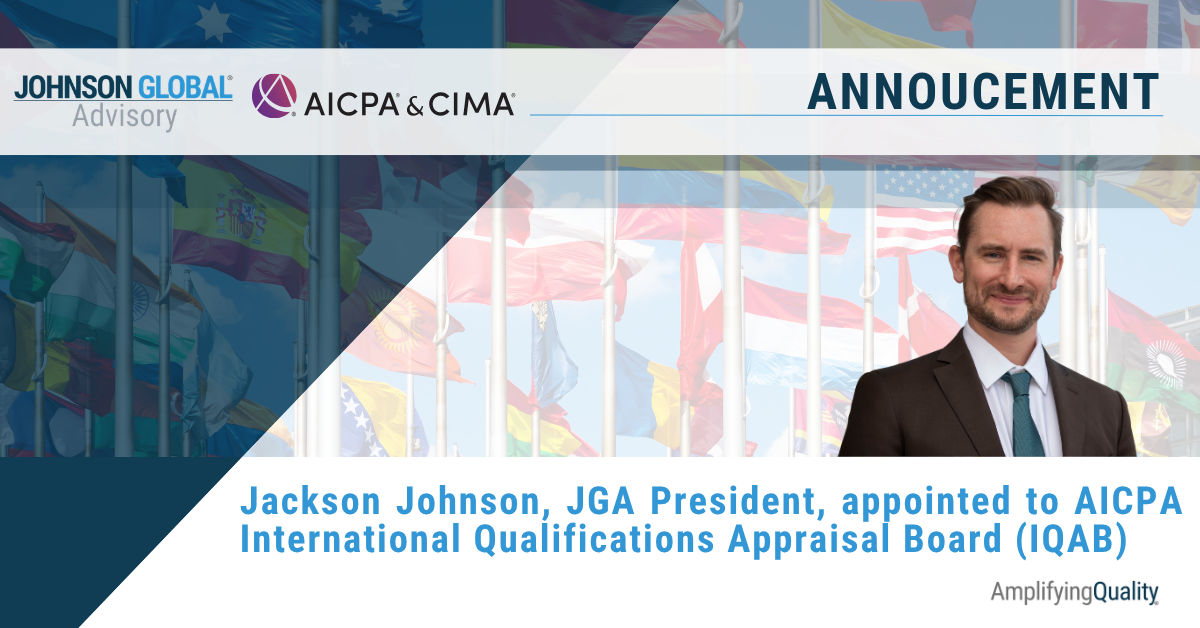
The PCAOB’s Technology Innovation Alliance (TIA) Working Group released a report on using AI, data analytics, and digital signatures to improve audit quality and investor protection. It recommends standardizing documentation, adopting responsible AI, and fostering innovation. Joe Lynch , JGA Managing Director, contributed insights as a stakeholder in the TIA roundtables and panels.
By Jackson Johnson August 18, 2025
Learn how to build your firm’s quality management system on time with actionable insights from Joe Lynch , Managing Director at JGA, as featured in the Journal of Accountancy . This article outlines eight strategic steps to ensure effective and timely implementation of quality management practices for your business.
By Jackson Johnson August 8, 2025
If you feel like you’ve read this story before, you’re not alone. For the third year in a row, the PCAOB’s annual report on broker-dealer audits paints a familiar picture: high deficiency rates, recurring issues in revenue testing, and quality control systems that continue to fall short. The 2024 report marks more than a decade of inspections under the interim program - and yet, many of the same red flags remain. At JGA , we’ve tracked and provided our insights on these annual reports closely for the last several years¹. While we always take the PCAOB’s findings seriously, we also know that behind every statistic is a firm doing its best to navigate complex standards, resource constraints, and evolving expectations. That’s why Jackson Johnson , JGA President & Founding Shareholder, sat down with Tanieke Samuel , JGA Director, to unpack this year’s latest BD report - not just to highlight some noteworthy findings, but to translate them into practical guidance for firms working hard to get it right. Revenue Testing: A Familiar Story with New Implications Jackson Johnson (JJ) : The PCAOB flagged revenue testing as a recurring issue again this year - 48% of audits had deficiencies in this area. That’s consistent with 2023, but still a big jump from 34% in 2022. And the deficiencies weren’t limited to one revenue stream - they spanned commissions, advisory fees, 12b-1 fees, and more. Why do you think this continues to be such a challenge? Tanieke Samuel (TS) : ASC 606 isn’t new. The PCAOB isn’t moving the goalposts. What we’re seeing is that firms are still struggling to test revenue accurately - across all sources. In many cases, they’re not getting a solid understanding of how revenue is generated, and that’s where the breakdown starts. Whether it’s commissions, trailing fees, or advisory income, you have to understand the components and tailor your testing accordingly. And don’t overlook presentation and disclosure - if you’re lumping everything under ‘commissions’ without disaggregating or explaining the sources, that’s a red flag. Audit Committee Communications: A Missed Opportunity JJ : One of the more surprising findings this year was the uptick in deficiencies related to audit committee communications. The PCAOB cited failures to communicate the overall audit strategy, use of specialists, significant risks like related parties, and even uncorrected misstatements. These seem like foundational elements. What’s going wrong? TS : These aren’t gray areas. The standards are clear. But I think some firms are treating these communications as a formality - just rolling forward last year’s template. That’s risky. Audit committee communications should be a strategic touchpoint. You need to clearly explain your audit strategy, surface the right risks, and give the committee what they need to fulfill their oversight role. If you’re using specialists or identifying related party risks, those need to be part of the conversation - not an afterthought. JJ : This reminds me of recent Actionable Insights we issued earlier this year , where we encouraged firms to move beyond the standard AS 1301 checklist and use the PCAOB’s Spotlight as a conversation starter. Audit committees want more than compliance - they want clarity, prioritization, and meaningful dialogue. When firms treat these communications as a strategic opportunity, they not only meet the standard - they build trust and demonstrate value. Agree? TS : Absolutely. I’ve seen audit committees respond really well when firms take the time to prepare thoughtfully - bringing key issues to the forefront, previewing the discussion in advance, and even holding deep dives on emerging topics. It’s not just about what you say - it’s about how you engage. That’s what makes the difference. Journal Entry Testing: Still a Blind Spot JJ : Journal entry testing continues to be a pain point. The PCAOB noted that firms often fail to test the completeness of the population or apply meaningful fraud risk criteria. In some cases, teams just scan the listing and move on. Why is this still happening? TS : Some firms think that because they’ve tested certain entries substantively elsewhere, they don’t need to do more. But that misses the point of journal entry testing as a fraud detection tool. You have to start by asking: What fraud risks are relevant to this client? Then design your testing around those risks. Don’t just look for a keyword - think about what would actually raise a red flag in this environment. And document your rationale. That’s what separates a thoughtful procedure from a perfunctory one. JJ : Are you seeing this as a broker-dealer-specific issue, or is it just as prevalent in issuer audits? TS : It’s definitely broader. JJ : Across issuers and BD inspections, we’ve seen comment forms where teams selected journal entries based on high-dollar thresholds or year-end timing but didn’t tie those selections back to the fraud risk discussion. In one case, the team documented their criteria but didn’t evaluate whether the entries actually addressed the override risk they had identified. In another, the team selected entries from a non-representative population and didn’t test completeness. What specifically in BD-only firms are you seeing? TS : In BD-only firms, especially smaller ones, the journal entry population might be smaller, which can give a false sense of simplicity. That can lead to shortcuts - like scanning instead of testing. In issuer audits, the volume and complexity might be higher, but the same root issue shows up: teams not linking their procedures back to the fraud risk assessment. Whether it’s a BD or an issuer, the key is to critically evaluate your criteria and make sure your testing is responsive to the risks you’ve identified. QC 1000: Turning Insight Into Action JJ : With QC 1000 going into effect at the end of the year, firms have a real opportunity to use the PCAOB’s findings as a risk assessment tool. But it’s not just about checking a compliance box - it’s about using these findings to inform a more thoughtful, iterative approach to quality. For example, we’ve emphasized the importance of root cause analysis (RCA) as a foundation for risk assessment. TS : Exactly. I emphasize to clients that RCA helps firms move beyond surface-level fixes and identify systemic issues that may be contributing to recurring deficiencies. When firms use PCAOB findings as inputs into their RCA process, they’re not just reacting - they’re proactively identifying where their system might be vulnerable. RCA helps connect the dots between what went wrong and why it happened, which is essential for designing controls that actually work. It’s not just about fixing the symptom - it’s about addressing the underlying condition. JJ : As firms read this report and try to make sense of how to incorporate it into their QC 1000 implementation, how should they approach this? TS : I would say incorporating the observations from this report and reflecting the applicability to your own practice is the concept of continuous improvement. This is a foundational concept of QC 1000. Implementation is about more than policies - it’s about culture . It’s about how you learn from what’s happening in the field and apply it to how you manage risk across the firm. When risk assessment becomes a living process - not a one-time exercise - firms are better positioned to adapt, improve, and ultimately deliver higher-quality audits. That’s the mindset shift we’re encouraging. ¹See our Actionable Insights on the PCAOB’s annual broker-dealer inspection reports from each year by entering “broker-dealer” on the search bar of the JGA Advisor page on our website. At Johnson Global Advisory, we support firms in selecting, implementing, and optimizing these tools to meet their unique needs. For more insights, visit our blog or contact us to learn how we can help your firm AmplifyQuality®. For more information, reach out to your JGA audit quality expert .