AI Governance Belongs in the Boardroom, Not the Server Room
Few technologies have generated as much excitement—and as much promise—for accounting firms as artificial intelligence (“AI”). The potential to streamline audit execution, reduce hours, and enhance firm profitability is real and already being realized. However, AI does not simply change how audits are performed; it fundamentally alters how firms must think about oversight, responsibility, and quality management. As regulators sharpen their focus on AI‑enabled audits, firm leadership must move beyond adoption and address a more complex challenge: establishing clear and scalable AI governance. This article outlines why AI governance is now a strategic imperative for accounting firm leadership.
As discussed in JGA’s article What Regulators Expect to See When AI is Used, inspectors do not evaluate AI tools in isolation. They evaluate whether the engagement team obtained sufficient appropriate audit evidence, exercised professional skepticism, and applied appropriate supervision and review when AI was used. Those expectations are grounded in existing auditing standards and apply regardless of whether AI was used for risk assessment, testing, or documentation support.
Against that backdrop, AI governance is not simply about approving tools or managing technology risk. It is about ensuring the firm’s system of quality management supports consistent, supervised, and well-documented use of AI that aligns with audit objectives and withstands inspection scrutiny.
When firms treat AI as an IT matter, governance discussions tend to center on 1) Data security, 2) System access, 3) Vendor due diligence, and 4) Infrastructure controls. Those topics matter—but they are only the baseline.
Inspectors do not evaluate whether AI systems are well engineered; they evaluate whether AI enabled audit work complies with standards, supports professional judgment, and is governed within the firm’s system of quality management. In short, AI governance is a firmwide audit quality issue, not a back office technology function.
Using AI does not change the auditor’s responsibilities.
Requirements still apply when AI is used for 1) Audit evidence, 2) Professional skepticism, 3) Supervision and review, 4) Engagement partner accountability and 5) Firm level quality controls.
From an inspection standpoint, AI introduces new audit quality risks, including:
- Over reliance on automated outputs
- Reduced professional skepticism (automation bias)
- Inconsistent application across engagements
- Insufficient documentation of judgment
- Lack of transparency around how conclusions were reached
These are not IT risks—they are audit quality risks.
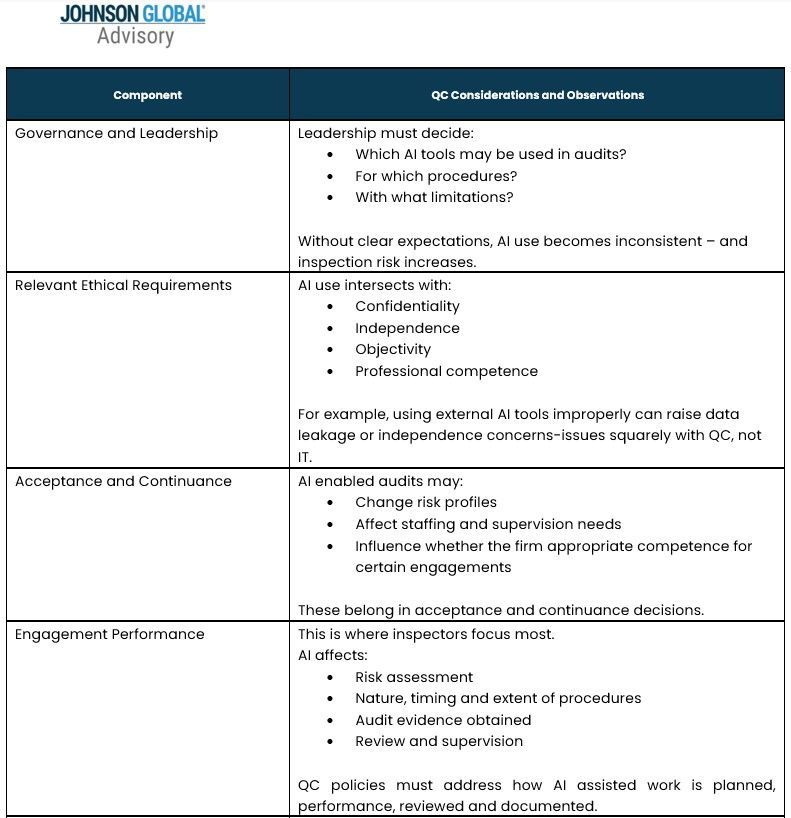
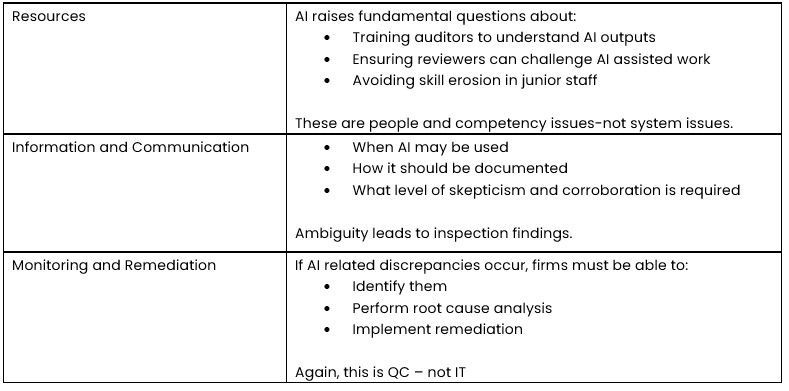
AI Touches Nearly Every Component of a QC System
Under modern quality management frameworks (including PCAOB QC 1000 , AICPA SQMS No. 1, IAASB ISQM 1), AI affects nearly every component of a firm’s QC system, not just technology or data governance.
What Inspectors Expect to See in Practice
When inspectors encounter AI use, they are not evaluating software architecture. They are evaluating whether the firm’s quality management system supported appropriate engagement-level execution.
Firms that treat AI governance as an IT issue often struggle to demonstrate this linkage. The result is not a technology finding, but an audit quality finding rooted in insufficient documentation, unclear supervision, or unsupported reliance on AI outputs.
They expect to see:
- Governance and formal approval processes for AI tools
- Alignment of the AI to the audit objectives
- Assessment of reliability of inputs and validation of outputs
- Robust supervision and engagement partner involvement
- Evidence of professional skepticism throughout the AI audit procedures
- Inspection ready‑ documentation explaining why AI was used and how results were evaluated
Firms that treat AI governance as an IT issue often struggle to produce this evidence.
What it Means for Firm Leadership
When AI is used in the audit, inspectors still expect rigor how the tool is selected and applied consistently across the Firm’s practice.
That is why AI governance cannot be delegated solely to IT. It must sit within the firm’s quality management system, with accountability owned by audit leadership.
- Ownership belongs with firm leadership, audit quality/risk functions, and engagement leadership — the groups responsible for the system of quality management.
- In an inspection, our experience shows that firms must show who approved the use case, how it was supervised, and how outputs were validated. Audit leadership (not the engagement teams) should have these answers.
IT still plays a vital enabling role—secure environments, access controls, data governance, vendor risk management, and system reliability. The difference is that these controls should be designed and operated in support of audit quality governance, not as a substitute for it.
So, the key question for leadership is not “Is our AI tool secure and approved by IT?” It’s: “Is our use of AI governed, supervised, and documented in a way that supports audit quality.” When done effectively, strong governance paves the way for firm leadership to realize the many operational and profitability benefits of AI usage.
Practically, that means leaders should be able to point to:
- A clear approval and permitted-use process for AI tools and use cases
- Defined expectations for supervision, partner involvement, and review of AI assisted work
- Requirements for validating inputs/outputs and addressing limitations or conflicting evidence
- Documentation explaining why AI was used, how results were evaluated, and how judgment was applied
Final Thoughts
For firm leadership, the message is increasingly clear: AI is already influencing how audits are planned, executed, and concluded—whether firms formally acknowledge it or not. The efficiency and profitability gains are real and compelling, but so too are the quality, inspection, and reputational risks when AI use is not intentionally governed. As AI becomes embedded in audit delivery, governance is no longer a technical afterthought—it is a firm‑wide leadership responsibility. For the C‑suite, the challenge is no longer whether AI should be used, but whether the firm has established the governance, accountability, and oversight necessary to ensure that AI enhances audit quality and withstands regulatory scrutiny. That determination, and its consequences, ultimately rest with firm leadership.
Ultimately, AI governance is a strategic business decision, not an IT assignment. How firm leadership responds will shape not only audit quality outcomes, but also the firm’s regulatory posture, client trust, and long‑term competitiveness.
Need help turning these considerations and observations into a practical governance model (policies, training, approval workflows, and documentation standards)? Contact your JGA audit quality expert to schedule a consultation and assess whether your firm’s reliance on AI is supportable.
Johnson Global partners with leadership of public accounting firms, driving change to achieve the highest level of audit quality. Led by former PCAOB staff, JGA professionals are passionate and practical in their support to firms in their audit quality journey. We accelerate the opportunities to improve quality through policies, practices, and controls throughout the firm. This innovative approach harnesses technology to transform audit quality. Our team is designed to maintain a close pulse on regulatory environments around the world and incorporates solutions which navigates those standards. JGA is committed to helping the profession in amplifying quality worldwide.