Navigating AI Governance: JGA Authors Governance & Compliance Chapter of the Accounting AI Playbook
This is an exert of the AI Accounting Playbook.


Building Trust in AI Accounting

As accounting firms adopt AI tools in audits, they face new questions about reliability, transparency, and compliance. Regulators like the PCAOB have made clear that if AI outputs can’t be explained or reproduced, they could violate existing standards. Yet formal guidance on AI use in audits remains limited, leaving firms unsure about how to move forward.


Some firms have responded by limiting AI to non-public clients, but this caution also presents a chance to lead. Firms that build strong AI governance practices now can stay ahead of future regulation and establish trust in their use of AI. This chapter covers key compliance barriers, governance best practices, and steps to create a trusted control environment.


Key Compliance Barriers

Accountants face several key compliance barriers when using AI, particularly as regulators such as the PCAOB, AICPA, and SEC increase their scrutiny.


Explainability

One major challenge is explainability. Many AI models, especially machine learning and generative AI, don’t clearly show how they reach conclusions. This is a problem for auditors who need to support their findings. 


This lack of clarity makes it harder to meet audit evidence requirements, which must be sufficient, appropriate, and easy to understand, as outlined in PCAOB standard AS 1105.


Poor Documentation

Poor documentation is another major issue. This includes inadequate records of data inputs and outputs, training data, model logic, and controls over changes.


Such deficiencies may violate documentation and risk assessment requirements, as seen when audit teams use AI for journal entry testing without documenting the rationale for flagged entries or threshold settings.


Data Privacy

Data privacy becomes a concern as firms use AI to handle large amounts of sensitive financial and personal information. This can lead to violations of laws like GDPR and CCPA, especially when client data is processed in cloud or third-party systems.


Firms often struggle to maintain consistent policies for data classification, encryption, and access. Auditor independence may also be at risk if AI tools are built by a firm’s advisory armor are deeply integrated with a client’s systems. For instance, if both the firm and client use the same predictive AI tool for forecasting, it could lead to a self-review threat.


AI Skills Gap

A skills gap and overreliance on AI further complicate compliance. Many auditors lack the training needed to critically evaluate AI outputs or to recognize when human judgment should override algorithmic conclusions.


This can lead to audit failures, such as misinterpreting a false negative from an AI-driven risk assessment as a clean result. 


Validation and Testing

Testing and validating AI tools is another challenge, especially for tools that keep learning over time. Firms need to test tools when they’re first used and then on a regular basis, just like they do when relying on third-party service providers.


But this is hard to do if the AI vendor doesn’t offer enough detail about how the tool works or the controls in place.


Change Management

Managing updates and changes to AI models is a concern. If a tool is updated or retrained without documentation, it can lead to inconsistent results.


For example, a model may flag different transactions in different quarters without any clear reason why. Many firms also lack a formal AI governance plan tied to their quality management systems, which causes inconsistent control practices and unclear responsibilities.


Lack of Guidance

Regulators have been slow to issue formal guidance on how AI should be integrated into the audit process, leaving many firms in a state of uncertainty.


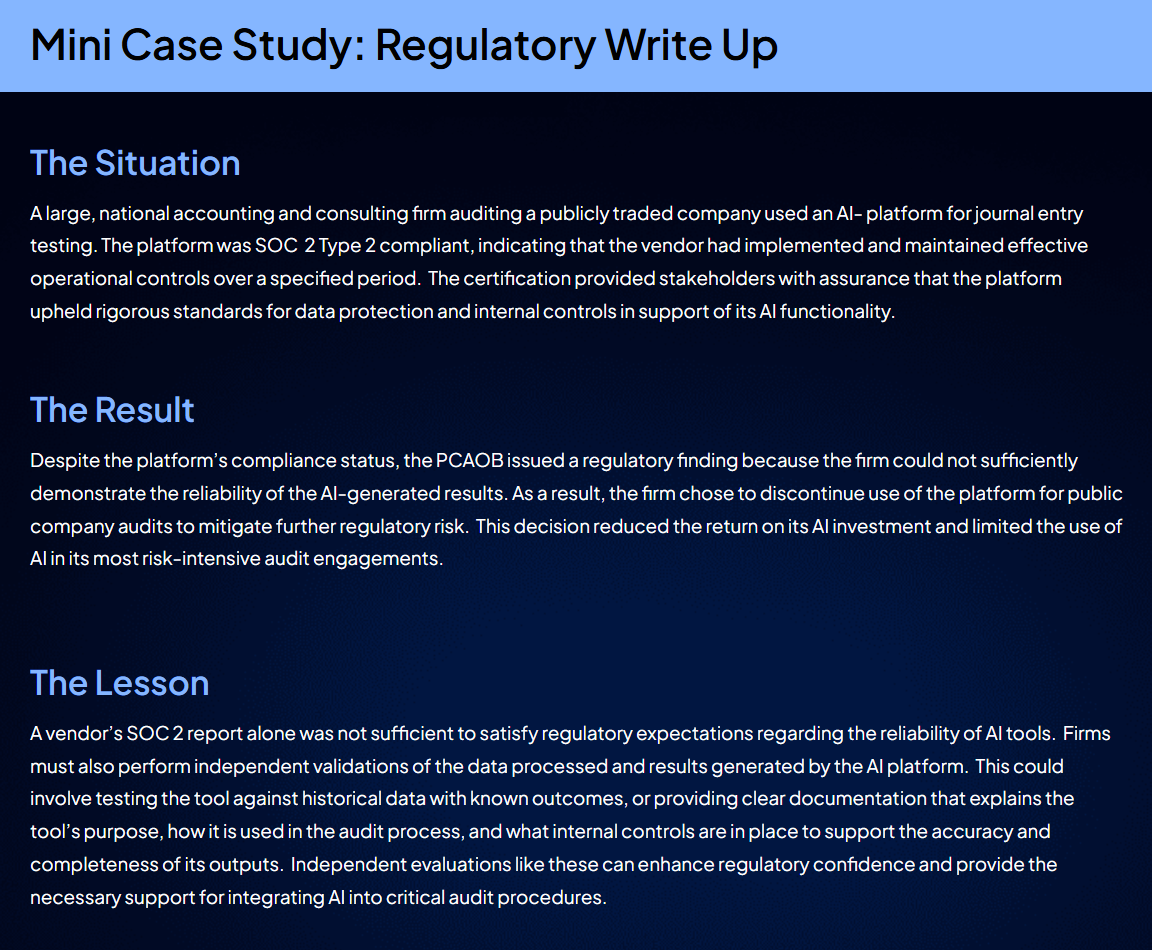
The good news is that momentum is building. PCAOB Board Member Christina Ho has publicly emphasized the transformative potential of AI in auditing, particularly in automating routine tasks such as cross-referencing data, extracting key contract terms, and documenting interviews. She has advocated for the PCAOB to evolve its standards to promote responsible AI use, calling for transparency, bias mitigation, and auditability in AI tools.


Similarly, the International Auditing and Assurance Standards Board (IAASB) has demonstrated its commitment to supporting firms by releasing its Technology Position, which is a strategic framework that outlines how the board will adapt auditing standards to align with emerging technologies, including AI.


Until these guardrails are firmly in place, firms should proactively develop internal AI frameworks modeled on established control standards. COBIT can support firms in assessing and governing AI systems, including data and system integrity. COSO can be applied to evaluate AI governance, model risk, and internal control implications, particularly when AI impacts financial reporting or ICFR. NIST provides guidance to help firms build trustworthy AI systems and establish appropriate cyber security and governance protocols.


Best Practices for Governance

To use AI confidently and compliantly in accounting, especially in regulated environments like audit and assurance, firms should implement strong governance practices that align with both regulatory expectations and ethical standards.


1. Test AI Internally Before Use In Engagements

Before you bring AI into your audits, you’ll need to put it through its paces. The starting point is an internal review and certification process, ideally led by your firm’s risk or national office. They should evaluate the AI tool’s design, logic, and controls, and may require your vendor to share documentation, control reports, and allow independent testing.


A great way to do this is by running the AI on historical data from past audits with known results. That helps confirm whether the AI delivers the same conclusions auditors already reached.


Scenario analysis is another smart move. Challenge the AI with tricky edge cases like known fraud or anomalies. This can expose blind spots or bias in the model.


Be sure to maintain a complete audit trail of how the tool was tested and what controls were in place. If any issues pop up during testing, document and resolve them.


And before you roll it out firm-wide, get an independent review of the tool. Think of it like a second set of eyes, similar to a concurring partner review. Only once your firm is fully confident in the tool should it be used in your accounting processes.


2. Develop AI Governance Policies

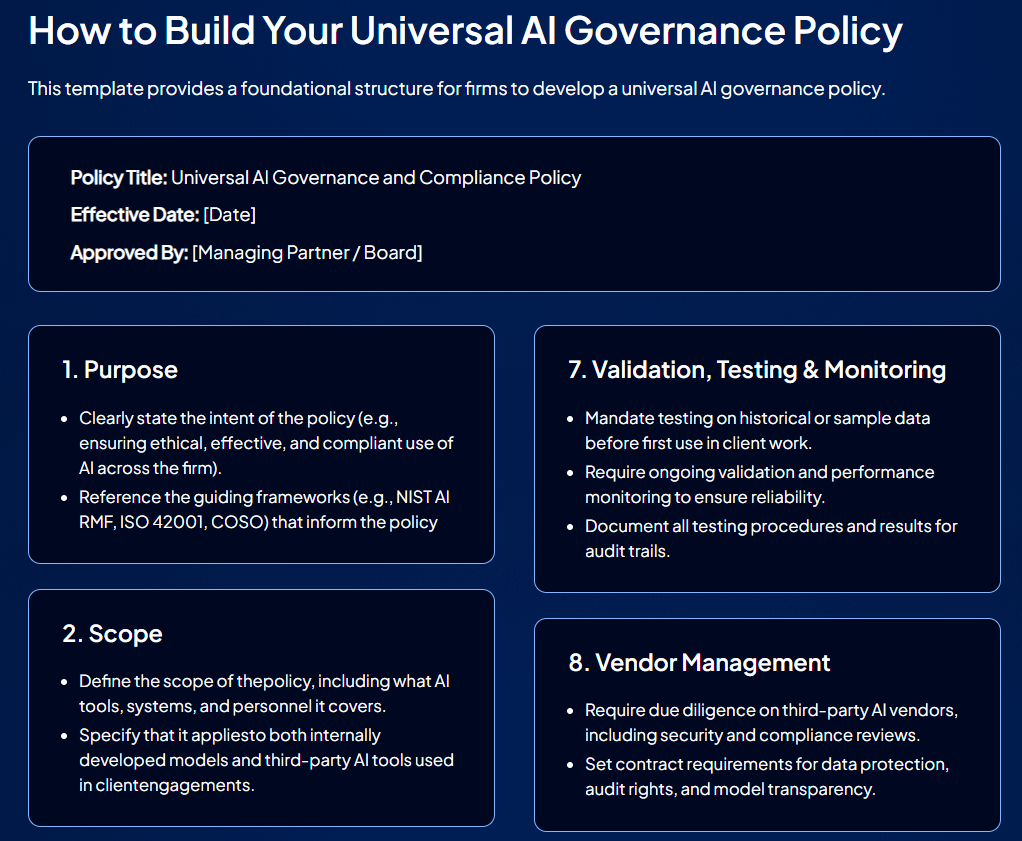
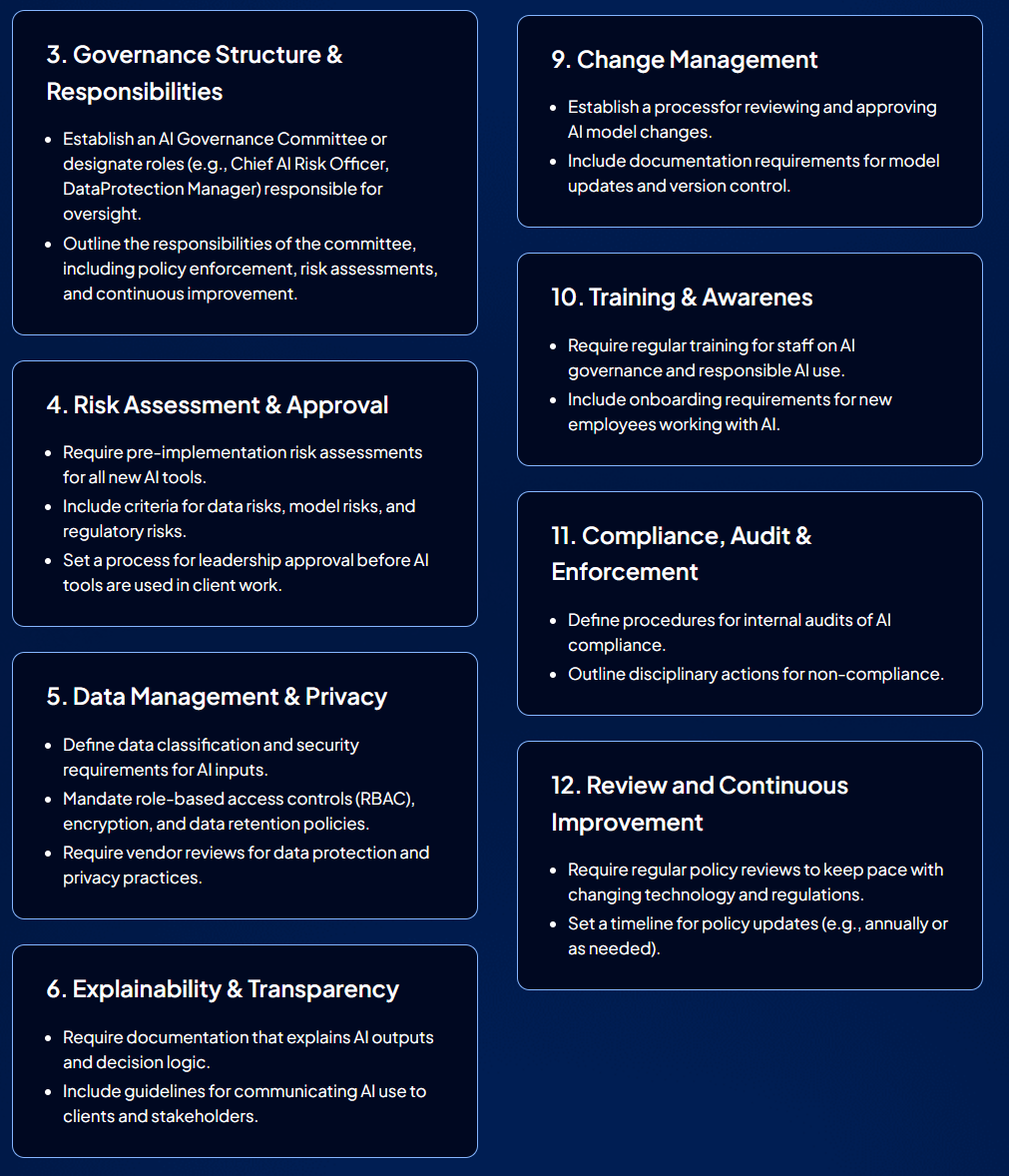
Strong policies lay the foundation for responsible AI use. These should outline your standards for data inputs, risk reviews, decision-making responsibilities, and transparency.


Deloitte recommends a universal governance policy that applies to all AI technologies across the firm. This policy should define acceptable (and prohibited) use cases, require approval for new AI tools, and establish review intervals.


Ethical usage also needs to be a priority. That means clear guidelines around privacy, bias, and legal compliance — with transparency as a core value. Internally and externally, stakeholders should understand when and how AI is being used in order to build trust in AI usage.


To oversee this, consider forming a dedicated AI GRC (Governance, Risk, Compliance) team. Roles might include a Chief AI Risk Officer, Data Protection Manager, AI Project Manager, and an AI Governance Committee.


Need help building your framework? Look to proven models like NIST AI RMF and ISO 42001. COSO’s recent guide Realize the Full Potential of AI shows how to extend COSO’s ERM framework to AI, and it’s a great place to start.


3. Implement Data Quality Controls

AI tools are only as reliable as the data they process. The old adage “garbage in, garbage out” underscores the importance of data quality in AI-driven accounting. To minimize the risk of inaccurate or biased AI outputs, firms should implement data validation, cleansing, and standardization processes. High-quality data improves AI performance and supports more reliable audit conclusions.


Protecting sensitive data is also crucial. Firms should limit access to confidential information using role-based access controls (RBAC) and multi-factor authentication (MFA). Audit logs tracking data access provide an added layer of oversight, helping firms monitor and secure critical information.


Data lifecycle management is equally important. Retention and deletion policies should be in place to ensure outdated data does not become a liability. While GDPR is an EU regulation, it sets a high standard for data management and serves as a strong benchmark for firms looking to enhance their data governance practices
AI Governance and Compliance Checklist

Use this checklist to guide your firm’s efforts in implementing sound AI governance and compliance practices.


Governance & Oversight

  • Have you designated an AI Governance Officer or committee to oversee AI tools and compliance?
  • Is there a formal AI governance policy that aligns with industry standards like NIST, COSO, and ISO?
  • Are AI use cases approved by firm leadership before deployment?


AI Inventory & Documentation

  • Have you created and maintained a complete inventory of all AI tools in use, including purpose, data sources, and vendor details?
  • Is there a process for documenting model logic, data inputs, outputs, and changes?
  • Are your AI systems mapped to specific regulatory requirements (e.g., PCAOB, SEC, AICPA)?


Explainability & Transparency

  • Can your AI tools provide clear, explainable outputs that meet audit evidence standards?
  • Are you documenting how AI tools reach their conclusions to support audit transparency?
  • Are engagement teams aware of the limitations and appropriate uses of AI tools?


Data Privacy & Security

  • Are data inputs for AI tools classified by sensitivity and protected by strong access controls?
  • Have you implemented encryption, role-based access (RBAC), and audit logs for AI data?
  • Are vendor data protection practices verified before use in client engagements?


Bias & Fairness Checks

  • Are you regularly testing AI tools for bias or unfair outcomes?
  • Are you adjusting models or their use if bias is detected?
  • Are you following emerging best practices for bias mitigation and fairness in AI?


Validation & Testing

  • Are AI tools tested on historical data before deployment?
  • Are you performing scenario analyses with edge cases to identify potential weaknesses?
  • Are you documenting all testing procedures and results for audit trails?


Change Management

  • Is there a formal process for reviewing and approving AI model changes?
  • Are you documenting all changes to AI models, including rationale and expected impact?
  • Are engagement teams informed of significant AI model updates that could affect results?


Regulatory Alignment

  • Have you mapped AI usage to relevant standards (e.g., PCAOB AS 1105, AICPA Code of Conduct)?
  • Are you maintaining documentation to demonstrate AI compliance to regulators?
  • Are you tracking regulatory developments to update your AI practices as needed?


Ongoing Training & Review

  • Are staff regularly trained on AI governance policies and best practices?
  • Are you conducting periodic reviews of AI use and compliance?
  • Are you updating your governance approach as AI technology and regulations evolve?


This checklist can be incorporated into your firm's quality control program, supporting the responsible use of AI tools and alignment with U.S. regulatory expectations.
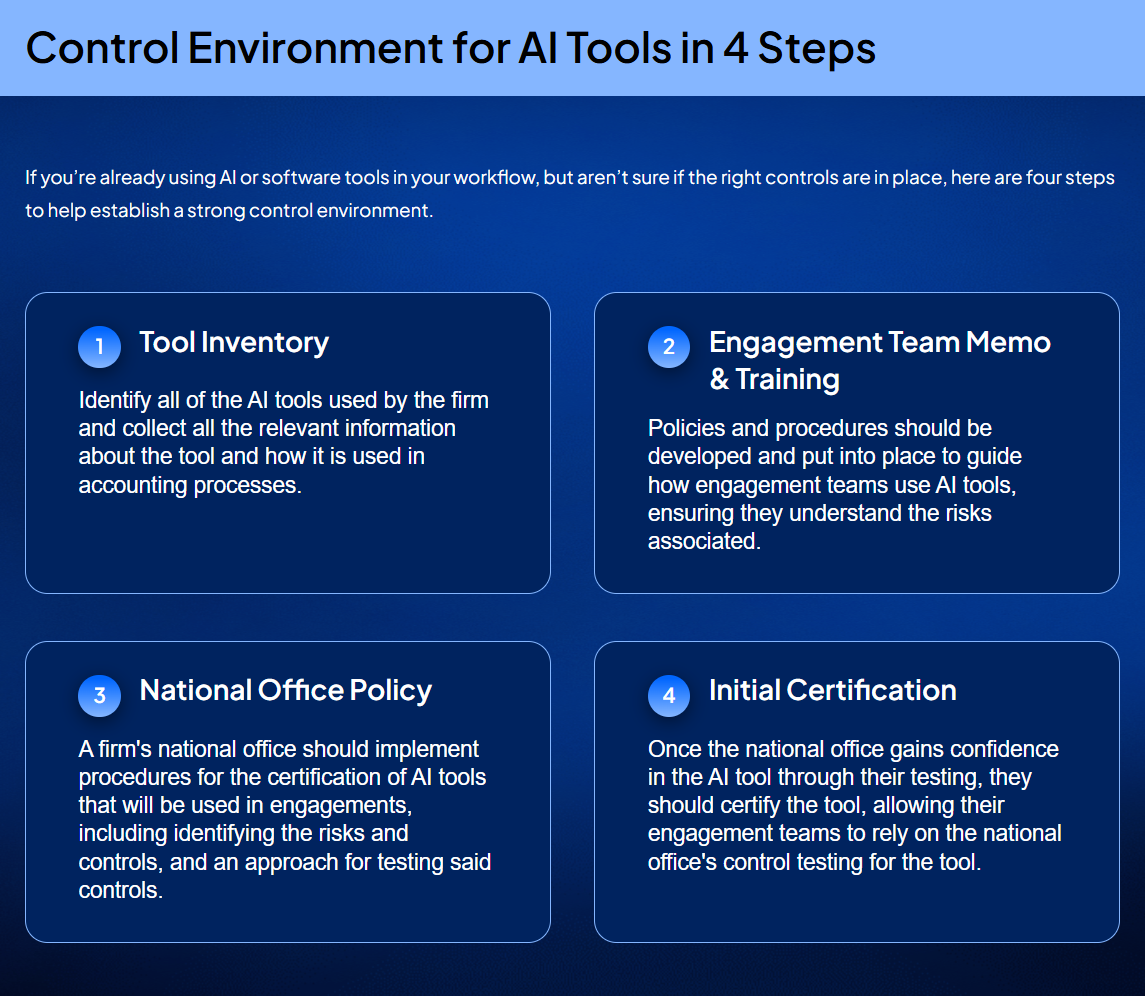
Chapter Summary

As AI becomes more integrated into accounting, firms must navigate regulatory complexities to ensure compliance and reliability. This chapter delves into key governance challenges, including regulatory uncertainty, explainability, and data privacy risks. It outlines best practices for AI implementation, such as internal testing, developing governance policies, and implementing data quality controls. Through a real-world case study and structured methodology for building a control environment for AI tools, readers will gain a comprehensive roadmap for establishing a compliant AI framework that fosters trust and strengthens audit integrity.

This is an exert of the AI Accounting Playbook.


About Johnson Global Advisory 

Johnson Global partners with leadership of public accounting firms, driving change to achieve the highest level of audit quality. Led by former PCAOB and SEC staff, JGA professionals are passionate and practical in their support to firms in their audit quality journey. We accelerate the opportunities to improve quality through policies, practices, and controls throughout the firm. This innovative approach harnesses technology to transform audit quality. Our team is designed to maintain a close pulse on regulatory environments around the world and incorporate solutions which navigate those standards. JGA is committed to helping the profession in amplifying quality worldwide. 


Visit www.johnson-global.com to learn more about Johnson Global. 

May 20, 2026
Few technologies have generated as much excitement—and as much promise—for accounting firms as artificial intelligence (“AI”). The potential to streamline audit execution, reduce hours, and enhance firm profitability is real and already being realized. However, AI does not simply change how audits are performed; it fundamentally alters how firms must think about oversight, responsibility, and quality management. As regulators sharpen their focus on AI‑enabled audits, firm leadership must move beyond adoption and address a more complex challenge: establishing clear and scalable AI governance. This article outlines why AI governance is now a strategic imperative for accounting firm leadership. As discussed in JGA’s article What Regulators Expect to See When AI is Used , inspectors do not evaluate AI tools in isolation. They evaluate whether the engagement team obtained sufficient appropriate audit evidence, exercised professional skepticism, and applied appropriate supervision and review when AI was used. Those expectations are grounded in existing auditing standards and apply regardless of whether AI was used for risk assessment, testing, or documentation support. Against that backdrop, AI governance is not simply about approving tools or managing technology risk. It is about ensuring the firm’s system of quality management supports consistent, supervised, and well-documented use of AI that aligns with audit objectives and withstands inspection scrutiny. When firms treat AI as an IT matter, governance discussions tend to center on 1) Data security, 2) System access, 3) Vendor due diligence, and 4) Infrastructure controls. Those topics matter—but they are only the baseline. Inspectors do not evaluate whether AI systems are well engineered; they evaluate whether AI enabled audit work complies with standards, supports professional judgment, and is governed within the firm’s system of quality management. In short, AI governance is a firmwide audit quality issue, not a back office technology function. Using AI does not change the auditor’s responsibilities. Requirements still apply when AI is used for 1) Audit evidence, 2) Professional skepticism, 3) Supervision and review, 4) Engagement partner accountability and 5) Firm level quality controls. From an inspection standpoint, AI introduces new audit quality risks, including: Over reliance on automated outputs Reduced professional skepticism (automation bias) Inconsistent application across engagements Insufficient documentation of judgment Lack of transparency around how conclusions were reached These are not IT risks—they are audit quality risks. AI Touches Nearly Every Component of a QC System Under modern quality management frameworks (including PCAOB QC 1000 , AICPA SQMS No. 1, IAASB ISQM 1), AI affects nearly every component of a firm’s QC system, not just technology or data governance. 
May 20, 2026
Johnson Global Advisory ("JGA") is proud to announce that Joe Lynch, Shareholder, will be speaking on a panel at the 41st Midyear SEC Reporting & FASB Forum . Joe will deliver the PCAOB update on June 5, with attendance available both in person and virtually. This panel will summarize the activities of the PCAOB including: Recite new requirements for the lead auditor’s use of other auditors Anticipate the new standard, “The Auditor’s Use of Confirmation” Enumerate the new requirements of QC 1000, “A Firm’s System of Quality Control” Recall the guidance of the new auditing standard “General Responsibilities of the Auditor in Conducting an Audit” Understand the amendments addressing aspects of audit procedures that involve technology-assisted analysis of information in electronic form Learn about the proposal to replace existing auditing standards related to an auditor’s use of substantive analytical procedures Anticipate other Standard-Setting and Research Projects Summarize PCAOB inspection findings and enforcement activities Understand recent PCAOB publications, including: Spotlight Publications Audit Focus Publications Data Points Publications Click here to register and learn more. Johnson Global partners with leadership of public accounting firms, driving change to achieve the highest level of audit quality. Led by former PCAOB staff, JGA professionals are passionate and practical in their support to firms in their audit quality journey. We accelerate the opportunities to improve quality through policies, practices, and controls throughout the firm. This innovative approach harnesses technology to transform audit quality. Our team is designed to maintain a close pulse on regulatory environments around the world and incorporates solutions which navigates those standards. JGA is committed to helping the profession in amplifying quality worldwide. 
May 15, 2026
Johnson Global Advisory (JGA) has submitted its response to the PCAOB’s request for input on its 2026–2030 strategic priorities. Drawing on extensive experience supporting firms subject to PCAOB oversight, JGA’s comments emphasize a more modern, risk-based approach to regulation focused on audit quality, scalability, and transparency. View JGA's comments here. Johnson Global partners with leadership of public accounting firms, driving change to achieve the highest level of audit quality. Led by former PCAOB staff, JGA professionals are passionate and practical in their support to firms in their audit quality journey. We accelerate the opportunities to improve quality through policies, practices, and controls throughout the firm. This innovative approach harnesses technology to transform audit quality. Our team is designed to maintain a close pulse on regulatory environments around the world and incorporates solutions which navigates those standards. JGA is committed to helping the profession in amplifying quality worldwide.
April 28, 2026
In our work with firms, we have seen a clear shift in how monitoring and remediation are viewed under modern quality management frameworks. They are no longer treated as retrospective compliance exercises. Instead, engagement deficiencies are increasingly used as meaningful inputs into an ongoing, risk-based system designed to identify issues early, address them thoughtfully, and reduce the likelihood of recurrence. Regulatory messaging reinforces this evolution. Oversight bodies are signaling a shift in focus from isolated engagement outcomes and more on whether firms have a system of quality management that consistently detects quality risks, responds appropriately, and demonstrates that remediation is working in practice. Based on our experience, while individual engagement deficiencies remain important, the more critical question is becoming how firms analyze, respond to, and learn from those issues over time. Engagement Deficiencies Are Signals, Not Endpoints Engagement deficiencies can surface through many channels, including pre-issuance reviews, internal inspections, post-issuance reviews, peer reviews, and regulatory inspections. Regardless of source, firms benefit most when these findings are evaluated through a consistent quality management lens. In practice, we encourage firms to look beyond whether a single engagement fell short . The more meaningful consideration is whether the deficiency points to potential weaknesses in governance, methodology, training, supervision, resourcing, or monitoring activities. We often observe that when issues are quickly labeled as engagement-specific, without assessing whether they reflect broader quality risks, valuable insight is lost. Modern quality management frameworks are designed to use these signals to strengthen the system, not simply close individual findings. What Effective Monitoring and Remediation Looks Like in Practice Firms that navigate this environment effectively tend to apply a disciplined and repeatable approach when deficiencies are identified. Based on our experience supporting firms across a range of practice areas, several elements consistently make a difference: Assess whether the issue may be systemic Recurring observations across engagements, service lines, or time periods often indicate system-level risk. Similar documentation gaps, inconsistent application of methodology, or supervision challenges rarely arise in isolation. Perform meaningful root cause analysis Effective root cause analysis typically moves beyond surface explanations. Firms benefit from evaluating whether policies and procedures were designed appropriately, implemented as intended, and supported by sufficient training, time, and resources. Design remediation that directly responds to the quality risk Remediation is most effective when it is clearly linked to the underlying risk. Depending on the circumstances, this may include enhancements to methodology, targeted training, revised review requirements, or changes to engagement acceptance, staffing, or oversight processes. Validate remediation through timely monitoring Implementing corrective actions is only part of the process. In our experience, firms are most successful when they also confirm that remediation operates as intended. Follow-up monitoring performed early enough to prevent recurrence is a critical component of this step. Failure to validate remediation remains one of the most common and consequential weaknesses we observe across firms. Case Study: When Remediation Is Not Validated In one situation we encountered, a firm identified engagement deficiencies through post-issuance reviews. The issues mirrored observations that had previously been noted during peer review and were communicated as having been addressed by the group responsible for report issuance. However, responsibility for validation was not clearly assigned, and no follow-up procedures were performed to evaluate whether the revised processes were effective. Subsequent post-issuance reviews, triggered by an organizational change, revealed that similar and additional deficiencies had re-emerged. From a quality management perspective, this was not an engagement execution failure. It reflected a breakdown in monitoring and remediation. The firm had information indicating quality risk but did not adjust its monitoring activities to confirm that remediation was working. Viewed through a system lens, this represents a system-level deficiency rather than an isolated engagement issue. Quality Management Applies Across All Engagement Types Modern quality management frameworks apply across a firm’s assurance and attestation practice, including private company audits, public company audits, SOC engagements, nonprofit audits, and other services. Deficiencies identified in any practice area may signal broader weaknesses in: Governance and leadership Methodology and training Monitoring activities Remediation processes In our experience, firms struggle to maintain an effective system of quality management when certain practices are treated as exempt from system-level evaluation. Key Takeaways Engagement deficiencies are inputs into the system, not endpoints. Recurring issues often indicate systemic quality risk. Remediation should be validated, not assumed. Monitoring activities should evolve as risks emerge. Quality management applies across all engagement types. Firms that treat monitoring and remediation as a continuous feedback loop, rather than a periodic exercise, are typically better positioned to improve engagement quality and respond to evolving regulatory expectations. Looking for an independent perspective on whether engagement deficiencies have been fully addressed? Based on our experience working with firms across assurance and attestation practices, Johnson Global Advisory supports clients by performing independent reviews, validating remediation efforts, and strengthening monitoring processes. If you would like support refining policies, training, workflows, or documentation standards, or would benefit from an objective assessment ahead of regulatory, peer, or internal inspections, contact your JGA audit quality advisor to discuss your needs.
April 28, 2026
Artificial intelligence (“AI”) is no longer experimental in public company audits. From risk assessment and scoping decisions to population testing, anomaly detection, and documentation support, AI enabled tools are increasingly embedded in audit execution and workflow. As use expands, the auditor’s core obligations do not shift to the technology, they remain with the engagement team. If AI is used to inform judgments, influence the nature, timing, or extent of procedures, or summarize and interpret information, auditors must still demonstrate that they obtained sufficient appropriate audit evidence and applied professional skepticism throughout. In practice, auditors must understand what the tool is doing, confirm that inputs are complete and accurate, and evaluate whether the outputs are reliable and fit for purpose in the specific audit context. While the auditing standard devoted solely to AI have not been issued, our experience is that inspectors have been increasingly direct—through staff publications, questions from inspectors in the field, and public remarks—about what they expect to see when AI is used. The expectations are grounded in existing standards and longstanding inspection focus areas: audit evidence, supervision and review, professional skepticism, and firm quality control (now quality management). In other words, AI does not create a “new” audit; it amplifies the need to show your work. Firms that treat AI as a “shortcut”, rely on outputs that cannot be explained or reproduced, or fail to govern and document how tools were selected, configured, and monitored are inviting new risks to support their audit conclusions. Conversely, firms that can clearly articulate the purpose of the tool, how it aligns to audit objectives, how inputs and outputs were validated, and how experienced personnel supervised and challenged the results will be far better positioned during inspection. The table below summarizes what inspectors typically expect to see documented when AI is used in a public company audit. Firms can use these themes to evaluate whether their engagement documentation tells a complete story that an experienced auditor (and an inspector) can follow from objective, to procedure, to results, to conclusion. 
March 30, 2026
In a previous article, Back to Basics: Audit Documentation Failures Have Become Dangerous Low Hanging Fruit , we highlighted how audit documentation had quietly re-emerged as a source of regulatory risk after years of relative deprioritization. While PCAOB Auditing Standard 1215, Audit Documentation (AS 1215), has historically been cited less frequently than other standards, our direct experience from recent inspection activity, enforcement actions, and internal inspection results, demonstrate that documentation failures are increasingly treated as indicators of deeper execution, supervision, and quality management breakdowns. In today’s environment, audit documentation is no longer merely a record of work performed. It is the primary evidence inspectors rely on to evaluate whether an engagement was properly planned, executed, and supported at the time the auditor’s report was issued. What has been low-hanging fruit now requires firms to close these gaps and transform them into a load-bearing foundation for audit quality. From Rare Enforcement to Systemic Inspection Risk AS 1215 establishes clear requirements regarding what must be documented, when documentation must be completed, and how engagement files must be assembled and retained. As discussed in our prior article, failures to comply with these requirements were historically viewed as technical or secondary issues, often resulting in inspection comments rather than enforcement action. That distinction is no longer meaningful. Recent enforcement actions involving backdating, improper (both intentionally, and inadvertent) modification of workpapers, and failure to timely assemble a complete audit file reflect an evolving regulatory view. Documentation failures do not simply violate procedural requirements; they call into question the credibility of the audit opinion itself. More importantly, beyond enforcement, documentation deficiencies are increasingly cited as core inspection findings. Inspectors are challenging situations where engagement teams assert that work was performed but cannot demonstrate that work within the archived file. In these cases, the absence of timely, complete, and clear documentation is no longer treated as a formality. It is treated as evidence that the engagement may not have been properly executed, supervised, or supported in accordance with PCAOB standards. This represents a fundamental shift. Documentation is no longer “low-hanging fruit.” It is a systemic inspection risk that cuts across execution, supervision, and firm-level quality management. From Misconduct to Execution Failures Pervasive documentation failures that do not involve intentional misconduct but still result in non-compliance are increasingly observed. For example, reviewer signoffs occurring near the documentation completion date, rather than contemporaneously with the performance of audit procedures, raise questions about whether effective supervision occurred during the audit or was deferred to meeting archiving deadlines. Similarly, engagement teams may assert that key judgments can be explained verbally, even when those judgments are not clearly documented in the audit file. In today’s environment, the distinction between “we can explain it” and “it is clearly documented” is critical. If procedures, judgments, and conclusions are not evident in the documentation itself, inspectors increasingly conclude that the work was not performed in accordance with PCAOB standards. The issue is not whether the engagement team can explain what they did after the fact. The issue is whether the archived documentation allows an experienced auditor, with no prior connection to the engagement, to understand the procedures performed, evidence obtained, and conclusions reached at the time of the auditor’s report. When documentation fails to reach that standard, inspectors are increasingly concluding that the audit itself was not properly executed, regardless of intent. This reflects an important shift. Documentation failures are no longer viewed primarily as misconduct. They are viewed as symptoms of execution breakdowns, including delayed supervision, compressed review cycles, and audit workflows that defer documentation until the end of the engagement. As a result, AS 1215 has become a direct proxy for how audits are actually performed in practice. How the 14-Day Documentation Completion Requirement Changes the Risk Profile The execution risks are further amplified by the PCAOB’s shortened documentation completion timeline. Recent amendments to AS 1215 reduce the timeframe to assemble a complete and final audit file from 45 days to 14 days after the report release date. While this change may appear procedural, its implications are operational. Under this accelerated timeline, engagement teams no longer have a meaningful post-issuance window to resolve review notes, complete documentation, or finalize supervisory evidence. What were once viewed as “clean-up” activities are now more likely to result in timing violations and non-compliance. This shift places increased emphasis on: Contemporaneous documentation Real-time supervision Realistic workload and staffing models Audit Documentation as a Cornerstone of Audit Quality Audit documentation has long been described as low-hanging fruit in the inspection process. That characterization no longer reflects its role in today’s regulatory environment. Documentation now serves as the primary lens through which regulators assess whether an engagement was properly executed, supervised, and supported. With shortened timelines, expanded quality management expectations, and increased regulatory scrutiny, firms can no longer treat documentation as a downstream activity. It must be embedded into how engagements are planned, staffed, reviewed, and completed. In an environment where inspection conclusions are driven by what is, and what is not, in the audit file, strong documentation is not merely defensive. It is foundational to audit quality. At Johnson Global Advisory , we support firms in selecting, implementing, and optimizing these tools to meet their unique needs. For more insights, visit our blog or contact us to learn how we can help your firm AmplifyQuality®. For more information, please contact your JGA audit quality expert .
March 30, 2026
Mergers and acquisitions within the accounting firm industry continue to accelerate, driven by succession planning needs, technology investment, talent constraints, geographic expansion, and the pursuit of new service lines. The pace and volume of transactions is being fueled, in large part, by private equity investment in the accounting firm space. Yet as deal activity accelerates, so does a critical reality: the long term success of an acquisition is determined well before the transaction closes—and long after the announcement is made. Experience across the profession shows that insufficient due diligence and poorly executed post acquisition integration are the most common sources of value erosion in accounting firm transactions. What the Regulator is saying and How JGA sees it At the AICPA December 2025 conference on Current SEC and PCAOB Developments, common topics were the presence of private equity in the accounting firm space and the opportunities and challenges that come with this investment. As it relates to private equity, then-acting PCAOB Chair George Botic noted that while these investments have the potential to enhance audit quality by increasing firm capacity and modernizing audit tools with advanced technologies, the presence of private equity presents a risk that firms shift incentives to prioritize profitability over audit quality. Mr. Botic stated, “Both AI and private equity investments in accounting firms carry the potential to truly reshape the profession. Yet these opportunities come with clear challenges to ensure that overreliance on AI and the pressures of private equity do not jeopardize audit quality.” At JGA, we expect the PCAOB to increase its inspection focus on a firm’s system of quality management. To the extent that acquisitions present quality risks to a firm, we expect increased attention from the PCAOB in terms of how firms are managing these risks. Due Diligence: Looking Beyond the Numbers Financial performance, partner buy ins, and deal structure naturally receive significant attention during an acquisition. However, professional services firms—particularly those providing audit and assurance services—certain of the greatest risks often reside outside the financial statements. Effective accounting firm due diligence must assess not only what the target firm has earned, but how it has earned it—and whether that performance is sustainable. This includes gaining a deep understanding of: Audit quality history, including inspection and peer review results, Independence, ethics, and regulatory compliance practices, Industries served, industry concentration and related expertise, Client concentration, retention trends, and engagement risk profiles, Partner governance, compensation alignment, and succession readiness, Technology platforms, data security, and scalability, and Firm culture, leadership dynamics, and decision making processes. When these areas are not rigorously evaluated, issues frequently surface after the transaction closing—when remediation is more disruptive, more expensive, and far more visible to regulators, clients, and staff. The Risks of Inadequate Due Diligence Inadequate diligence often leads to unanticipated post transaction challenges, including: Regulatory findings related to legacy engagements, Independence violations requiring retroactive remediation, Client attrition driven by service disruption or cultural misalignment, Talent loss stemming from unclear expectations or compensation inequities, and Technology incompatibilities that impair efficiency and data integrity. Deficiencies inherited through acquisition can affect inspection outcomes, firm reputation, and overall audit quality long after the transaction closes. Integration: Where Value Is Created—or Lost Even when due diligence is performed thoughtfully, post acquisition integration remains the most common point of failure. Integration is often underestimated, treated as an operational exercise rather than a strategic initiative requiring sustained leadership attention. Successful integration goes far beyond combining systems or standardizing branding. It requires deliberate alignment across how the firm operates, governs itself, and delivers quality—particularly in areas such as: Audit methodology and documentation standards Quality management systems and monitoring processes Partner roles, authority, and accountability Talent development, evaluation, and retention Communication with clients, regulators, and staff Absent a structured integration plan, firms risk operating as a collection of semi independent practices rather than a cohesive organization. This fragmentation can undermine consistency, weaken accountability, and complicate regulatory compliance. A Strategic Imperative in a Changing Profession As consolidation continues and regulatory scrutiny intensifies, rigorous due diligence and disciplined integration are no longer optional. They are essential to managing risk, sustaining quality, and realizing the full value of a transaction. For accounting firm leaders, the message is clear: growth through acquisition can be a powerful strategy—but only when supported by a comprehensive understanding of what is being acquired and a deliberate plan for how the combined firm will operate as one. Firms that treat diligence and integration as leadership imperatives—rather than transactional steps—are better positioned to protect audit quality, retain talent, and preserve client trust while achieving growth objectives. JGA’s Role Guiding Firms through these Opportunities For firms seeking to grow through acquisition without sacrificing quality, control, or visibility, JGA is a solution. JGA is uniquely qualified with deep experience working with accounting firms on quality management, governance, and operational transformation. We have proven due-diligence tools built that are designed to be practical, adaptable, and immediately usable—while also supporting long term consistency as firms pursue multiple acquisitions over time. Ready to get started or need help refining your acquisition activities? Contact your JGA audit quality expert today to schedule a consultation and ensure acquisition activities are tailored to your firm’s needs.
By Jackson Johnson February 24, 2026
WASHINGTON, D.C.: — Johnson Global Advisory (JGA) is proud to sponsor the ALI’s Accountants’ Liability 2026 conference hosted by the American Law Institute (ALI). The two‑day program will take place May 14–15, 2026, in Washington, D.C., with a live webcast option available for remote attendees. This annual conference is a premier forum for accounting firm leaders, in‑house counsel, litigators, and regulators to examine the evolving landscape of accountants’ liability, enforcement priorities, and risk management. The 2026 program will explore how recent regulatory, litigation, and technological developments are reshaping the profession and what firms can do to proactively respond. “We are pleased to once again sponsor the ALI Accountants’ Liability Conference,” said Jackson Johnson, President of Johnson Global Advisory. “This event consistently brings together leading regulators, practitioners, and risk professionals to discuss the most pressing liability and oversight issues facing accounting firms today. We value the opportunity to engage with participants and contribute to these important conversations.” The program will feature nationally recognized panels of practitioners, general counsel, industry professionals, and government officials. Planned discussions will address current and emerging challenges facing accounting firms, including: Regulatory and enforcement priorities impacting the accounting profession Recent trends in accounting‑related litigation PCAOB and SEC perspectives on audits, inspections, and gatekeeper liability The impact of AI, cryptocurrency, and emerging technologies on audit quality and firm risk Best practices for navigating an evolving and uncertain regulatory environment Register by April 13, 2026, to attend in-person and use the code “ JGA2026 ” to save $250 off . OR, for webcast attendance, use the code " JOHNSON " to save $125 off the tuition. Click here to register. To learn more about how Johnson Global partners with in-house and outside counsel to support public accounting firms, we invite you to explore our latest brochure. This resource outlines our approach to independent monitoring and consulting, including how we assist firms in navigating PCAOB and SEC investigations, implementing quality control improvements, and responding to regulatory findings. Download the brochure below to see how our experienced team can help your firm meet today’s compliance challenges and build a stronger foundation for the future. Get a copy of our brochure here . About Johnson Global Advisory Johnson Global partners with leadership of public accounting firms, driving change to achieve the highest level of audit quality. Led by former PCAOB and SEC staff, JGA professionals are passionate and practical in their support to firms in their audit quality journey. We accelerate the opportunities to improve quality through policies, practices, and controls throughout the firm. This innovative approach harnesses technology to transform audit quality. Our team is designed to maintain a close pulse on regulatory environments around the world and incorporates solutions which navigates those standards. JGA is committed to helping the profession in amplifying quality worldwide. Visit www.johnson-global.com to learn more about Johnson Global.

By Jackson Johnson February 24, 2026
We’re pleased to share that Joe Lynch , JGA Shareholder, will be presenting in a series of AICPA & CIMA webcasts focused on practical considerations for Quality Management. These sessions are designed to provide guidance in your QM journey. They support key elements such as engagement quality reviews, root cause analysis, and ongoing monitoring and remediation. Register for Upcoming Sessions Session 1 — Quality Management: Engagement Quality Reviews What you’ll learn: Practical considerations for your firm's responsibilities for engagement quality reviews and the reviewers requirements when executing engagement quality reviews under the updated quality management standards, including how to make EQRs scalable and effective. Register for this session here . Session 2 — Quality Management: Performing a Root Cause Analysis What you’ll learn: How root cause analysis supports remediation by identifying underlying drivers of the findings and deficiencies; supporting the design of corrective actions that prevent recurrence. Register for this session here . Session 3 — Quality Management: My System is Set Up — Now What? What you’ll learn: Post-implementation requirements of SQMS No. 1, which include monitoring activities, evaluating findings and deficiencies, remediation, and the annual evaluation process—so your system stays responsive and effective. Register for this session here . These sessions are included with a current Webcast Pass. At Johnson Global Advisory , we support firms in selecting, implementing, and optimizing these tools to meet their unique needs. For more insights, visit our blog or contact us to learn how we can help your firm AmplifyQuality®.
By Jackson Johnson January 20, 2026
JGA is pleased to announce that Joe Lynch , JGA Shareholder, will be a featured guest on the upcoming AICPA & CIMA A&A Focus live webcast on February 4, 2026. Joe has been invited to join the program to provide insights on changes to engagement quality review requirements. This appearance offers a valuable opportunity for viewers to gain practical, real-time guidance on effective EQR practices—an increasingly critical component of audit quality and compliance under the evolving professional standards landscape. Click here for m ore information about the program and registration details. At Johnson Global Advisory, we support firms in selecting, implementing, and optimizing these tools to meet their unique needs. For more insights, visit our blog or contact us to learn how we can help your firm AmplifyQuality®. For more information, please contact your JGA audit quality expert .